# Free body under thermal load. Unexpected Stresses
**URL:** https://calculix.discourse.group/t/free-body-under-thermal-load-unexpected-stresses/2360
**Category:** Uncategorized
**Created:** [August 2, 2024, 11:47am UTC](https://calculix.discourse.group/t/free-body-under-thermal-load-unexpected-stresses/2360 "2024-08-02T11:47:16Z")
**Posts on this page:** 13
**Page:** 1
### Author:  [@Disla](https://calculix.discourse.group/u/Disla)
#### Post date: [August 2, 2024, 11:47am UTC](https://calculix.discourse.group/t/free-body-under-thermal-load-unexpected-stresses/2360/1 "2024-08-02T11:47:16Z")
Hi,
I’m finding VM stresses at the end of a free expansion of this beam. Which could be the reason?
> **[Free Thermal Expansion Stress.inp](https://wetransfer.com/downloads/523e19a78fba2e8fad8762c8b562627020240802114646/c4cf77)**
>
> 1 file sent via WeTransfer, the simplest way to send your files around the world


---
### Author:  [@Calc\_em](https://calculix.discourse.group/u/Calc_em)
#### Post date: [August 2, 2024, 12:21pm UTC](https://calculix.discourse.group/t/free-body-under-thermal-load-unexpected-stresses/2360/2 "2024-08-02T12:21:39Z")
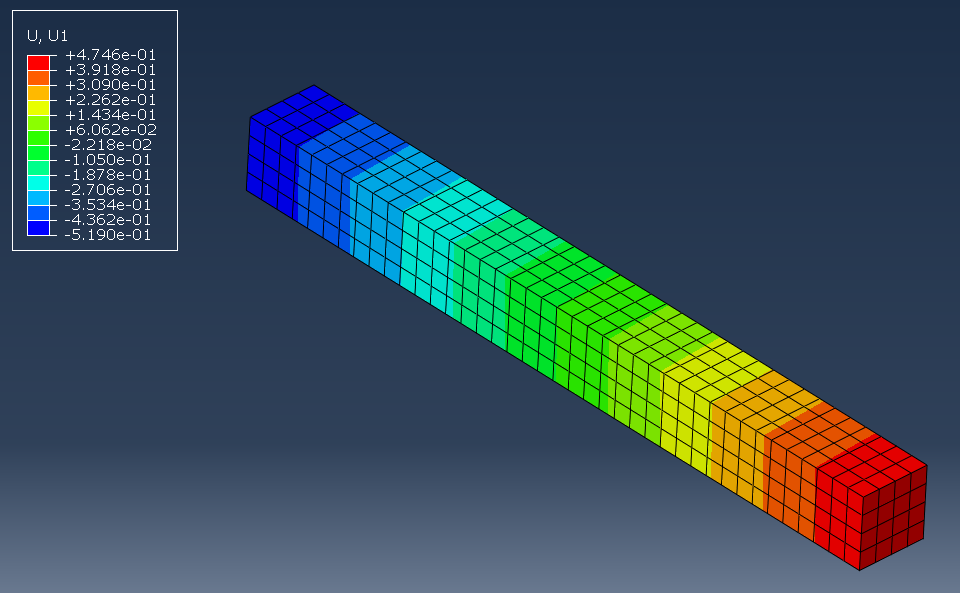
Abaqus results from this .inp:

---
### Author:  [@Disla](https://calculix.discourse.group/u/Disla)
#### Post date: [August 2, 2024, 12:27pm UTC](https://calculix.discourse.group/t/free-body-under-thermal-load-unexpected-stresses/2360/3 "2024-08-02T12:27:06Z")
Ohh!.
I agree with the free stress state, that’s what I would expect but displacements are weird isn’t it?
I would expect 0.4 and -0.4, symmetric expansion around the center and an overall 0.8 elongation of the beam.
---
### Author:  [@Calc\_em](https://calculix.discourse.group/u/Calc_em)
#### Post date: [August 2, 2024, 12:45pm UTC](https://calculix.discourse.group/t/free-body-under-thermal-load-unexpected-stresses/2360/4 "2024-08-02T12:45:14Z")
Without Nlgeom, the values are different:

With symmetry BCs to keep it in place:

linear:

It’s like with unconstrained pressure vessel subjected to uniform pressure load - minor disturbances can make it respond non-uniformly.
---
### Author:  [@Disla](https://calculix.discourse.group/u/Disla)
#### Post date: [August 2, 2024, 1:01pm UTC](https://calculix.discourse.group/t/free-body-under-thermal-load-unexpected-stresses/2360/5 "2024-08-02T13:01:15Z")
> [@Calc\_em](#):
>
> It’s like with unconstrained pressure vessel subjected to uniform pressure load - minor disturbances can make it respond non-uniformly.
Thank you very much Calc-em. That last picture is very interesting. Abaqus LINEAR result for displacements it is the same I’m obtaining but I am supposedly using the nonlinear solver. I have looked at the inp that Prepomax generates and I have seen that Nlgeom is correctly there.
¿?¿
---
### Author:  [@Calc\_em](https://calculix.discourse.group/u/Calc_em)
#### Post date: [August 2, 2024, 1:14pm UTC](https://calculix.discourse.group/t/free-body-under-thermal-load-unexpected-stresses/2360/6 "2024-08-02T13:14:29Z")
CalculiX result for the case with BCs and Nlgeom (should have the same results as in the second image in my previous post):

Maybe Nlgeom is not working correctly in this procedure.
---
### Author:  [@Disla](https://calculix.discourse.group/u/Disla)
#### Post date: [August 2, 2024, 1:26pm UTC](https://calculix.discourse.group/t/free-body-under-thermal-load-unexpected-stresses/2360/7 "2024-08-02T13:26:01Z")
I agree with your. NLGEOM is not active for the thermal part of the expansion.
---
### Author:  [@Calc\_em](https://calculix.discourse.group/u/Calc_em)
#### Post date: [August 2, 2024, 1:39pm UTC](https://calculix.discourse.group/t/free-body-under-thermal-load-unexpected-stresses/2360/8 "2024-08-02T13:39:34Z")
Might be worth reporting on GitHub then. Another important bug to notify Guido.
---
### Author:  [@vicmw](https://calculix.discourse.group/u/vicmw)
#### Post date: [August 4, 2024, 8:29pm UTC](https://calculix.discourse.group/t/free-body-under-thermal-load-unexpected-stresses/2360/9 "2024-08-04T20:29:45Z")
I wonder if you need to make an arbitrary choice of strain measure for large strains. Since CCX and Abaqus disagree on the length change, maybe they just have different assumptions about the meaning of CTE?
CCX hints at a difference from other codes which I don’t quite understand:
_“This establishes an exponential expansion relationship. This is fine, as long
as the thermal strain was also measured according to Equation(18), i.e. with
reference to the actual length. The latter approach, used by a lot of Finite
Element codes requires linear expansion coefficients for linear calculations (using
linear strain) and exponential ones for nonlinear geometric calculations (using
logarithmic strain). The approach in CalculiX avoids this.”_
It doesn’t explain the non-zero stress though. But perhaps that doesn’t really matter if there’s no real material that can have 40% thermal expansion and still remain a solid?
---
### Author:  [@JuanP74](https://calculix.discourse.group/u/JuanP74)
#### Post date: [August 5, 2024, 8:44am UTC](https://calculix.discourse.group/t/free-body-under-thermal-load-unexpected-stresses/2360/10 "2024-08-05T08:44:07Z")
I think you didn’t achieve the steady state.
---
### Author:  [@Disla](https://calculix.discourse.group/u/Disla)
#### Post date: [August 5, 2024, 11:17am UTC](https://calculix.discourse.group/t/free-body-under-thermal-load-unexpected-stresses/2360/11 "2024-08-05T11:17:51Z")
Hi JuanP74,
I’m imposing an increasing temperature to the body as a whole. Just in case I have look at final Heat flux and it’s negligible.

---
### Author:  [@JuanP74](https://calculix.discourse.group/u/JuanP74)
#### Post date: [August 5, 2024, 11:50am UTC](https://calculix.discourse.group/t/free-body-under-thermal-load-unexpected-stresses/2360/12 "2024-08-05T11:50:45Z")
You don’t have flux BC on your model so all heat is taken as internal energy by the beam. It is thermally insulated. Try using steady state parameter
---
### Author:  [@Disla](https://calculix.discourse.group/u/Disla)
#### Post date: [August 6, 2024, 9:18am UTC](https://calculix.discourse.group/t/free-body-under-thermal-load-unexpected-stresses/2360/13 "2024-08-06T09:18:31Z")
Hello JuanP74,
I have try the Steady Option and it doesn’t help. (Convergence is failing).
I have also increase some orders of magnitude the Thermal conductivity to help spreading any small temperature gradient and the result is the same.
Temperature is uniform in all the body after each iteration. From my point of view there shouldn’t be any Stress for this particular geometry. Something different would be in pressence of Gaussian curvature but this is not the case for a straight bar.